| Advanced Materials | |
|---|---|
| 년도 | 2026 |
| 학술지명 | Advanced Materials |
| 논문명 | Asymmetric Lamellar Templating of the Perovskite/C60 Interface for Scalable Inverted Perovskite Photovoltaics |
| 게재권/집 | 38/53 |
| 수록페이지 | e74316 |
| 저자명 | Taeyoon Ki, Jong-Guk Ahn, Sangcho Kim, Sangjin Kim, Min-Ho Lee, In-Wook Hwang, Jinju Jeong, Soobin Shim, Jaeboong Ahn, Jun Hong Park, Seungjin Lee, Jung-Yong Lee, Yousoo Kim, Ju-Hyeon Kim, Hongkyu Kang*, Sukwon Hong*, and Kwanghee Lee* |
| Link |
 https://doi.org/10.1002/adma.74316
194회 연결 |
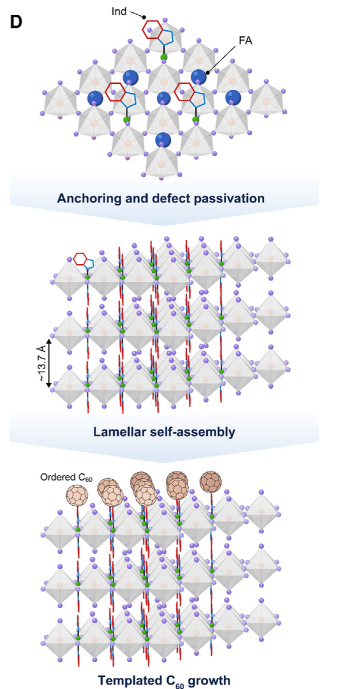
Abstract Scalable inverted perovskite solar cells require top interfaces that combine defect passivation with spatially uniform electron extraction as the device area increases. Low-dimensional capping layers based on bulky spacer cations can suppress surface recombination, but poorly controlled molecular packing often introduces transport barriers and local interfacial heterogeneity. Here, we introduce indol-3-ylethylammonium iodide (Ind) as a π-electron-rich spacer cation for asymmetric lamellar templating at the perovskite/C60 junction. The heteroatom-polarized indole framework creates lateral electrostatic anisotropy within the aromatic plane, promoting face-to-face spacer association and aligning the lamellar interphase. The resulting π-rich lamellar interphase suppresses interfacial recombination, preserves electron extraction, and improves spatial optoelectronic uniformity in large-area devices. Ind-based devices achieve a certified efficiency of 26.94% in small-area cells and a certified module efficiency of 23.21% for a 25 cm2 monolithic module. They further retain > 93% efficiency after 1000 h at 85◦C and maintain 85% of their initial efficiency after 1800 h under continuous 1-sun MPP tracking. These results identify lateral electrostatic anisotropy as a molecular design principle for scalable perovskite/C60 top interfaces. |
|
PUBLICATIONS
Advanced Devices for Energy Conversion